White Ring-neck Doves or Love Doves
Breeding
 Breeding
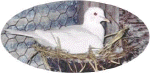
your Love Doves is an exciting adventure. If you
have a male and female, sooner or later the male will begin to coo and bow for
the female. He will select a nest site and call to the female to inspect the
area. It may be the feed bowl or the corner of the cage. At this time put a
small container into the cage and fill it with nesting material. The
container s Breeding
your Love Doves is an exciting adventure. If you
have a male and female, sooner or later the male will begin to coo and bow for
the female. He will select a nest site and call to the female to inspect the
area. It may be the feed bowl or the corner of the cage. At this time put a
small container into the cage and fill it with nesting material. The
container s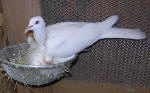 hould
be about 5 inches across and several inches deep. The most important thing is
that the bottom is not smooth. The young birds will develop "spraddle legs"
if the bottom is smooth. I have used plastic dog dishes with indoor-outdoor
carpet glued to the bottom. On top of that add nesting material. hould
be about 5 inches across and several inches deep. The most important thing is
that the bottom is not smooth. The young birds will develop "spraddle legs"
if the bottom is smooth. I have used plastic dog dishes with indoor-outdoor
carpet glued to the bottom. On top of that add nesting material.
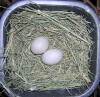 The
clutch consists of two eggs, laid 1 and 1/2 days apart. The incubation
period, or the time that the eggs are covered and kept warm by the parents is
14 days. Both the male and female will take turns incubating the eggs. The
eggs will hatch and the parents will remove the egg shells. Do not assist the
young out of the shell. The
clutch consists of two eggs, laid 1 and 1/2 days apart. The incubation
period, or the time that the eggs are covered and kept warm by the parents is
14 days. Both the male and female will take turns incubating the eggs. The
eggs will hatch and the parents will remove the egg shells. Do not assist the
young out of the shell. 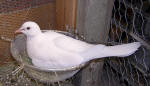
When the eggs are 3 to 5 days old, you can hold them against
a bright light and "candle" them -- or look inside to see if there is an
embryo. You will be able to see the blood vessels and embryo, unless the eggs
are infertile. Older eggs will be dark throughout with a clear air space at
one end. Infertile eggs will remain clear with just the yellowish yolk
showing. Doves notoriously have a high incidence of eggs that do not hatch.
Both parents feed the young,
starting with "c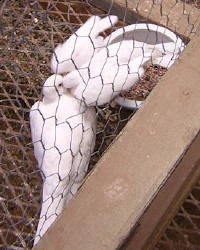 rop
milk" produced in their crops the first week. The crop is an enlarged area of
the esophagus where for holding food before it goes to the stomach. They
gradually feed more and more seeds as the baby grows. You will be able to see
the seeds in the crop area beneath the neck of the bird after it has been
fed. The young dove will insert the bill inside the bill of the parents and
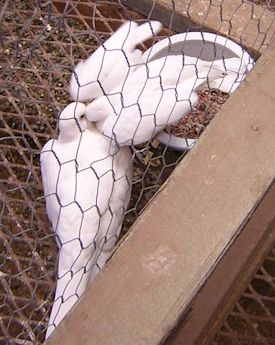
the parents regurgitate the crop milk and seed for the baby as shown in the
photo. rop
milk" produced in their crops the first week. The crop is an enlarged area of
the esophagus where for holding food before it goes to the stomach. They
gradually feed more and more seeds as the baby grows. You will be able to see
the seeds in the crop area beneath the neck of the bird after it has been
fed. The young dove will insert the bill inside the bill of the parents and
the parents regurgitate the crop milk and seed for the baby as shown in the
photo.
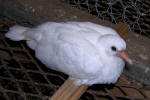 The
young Love Doves grow very fast being able to leave the nest in approximate 12
to 14 days. The parents will continue to feed it for a few days and then
begin another nest. You should probably remove the babies into their own cage
at that time. The
young Love Doves grow very fast being able to leave the nest in approximate 12
to 14 days. The parents will continue to feed it for a few days and then
begin another nest. You should probably remove the babies into their own cage
at that time.
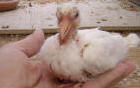
Young doves gradually molt their plumage (shed their
feathers and grow new ones) at about 30 to 40 days of age and then once more
before becoming mature at 5-7 months. Breeding doves molt once a year,
beginning in summer, but you will see loose feathers on the floor at any
time.
Doves can live several years; they are not considered old
until about 5 years or more and in captivity have been known to live and still
be producing young at 17 years of age!
   |